Translate

Showing posts with label social media. Show all posts

Saturday, July 09, 2016

Internet and digital landscape in Indonesia


Internet and digital landscape in Indonesia


With a growing connectivity and a large population that is extremely active online, Indonesia is one of the world’s leading countries for the use of digital technologies. Through Internet, mobile, e-commerce or social media, digital in Indonesia is a very attractive market both for its size and growth potential.
The latest figures available for the penetration of Internet, mobile and social media show that Indonesia’s large population is gradually adopting online technologies and already a massive market for mobile, fomenting an attractive ecosystem and market for mobile apps.

The following presentation highlights the details of various digital trends in Indonesia and its enormous potential for growth: especially the compared use of the different digital devices, mobile behaviors, e-commerce, leaders of the different digital industries, investments and advertising.


7 insights on digital in Indonesia – summary
  • Indonesia overview – slide 5
  • Audience behavior – slide 10
  • Mobile behavior – slide 14
  • E-commerce landscape – slide 18
  • Industry landscape – slide 25
  • Investment related – slide 30
  • Advertising industry – slide 36
  • Things to know before entering the Indonesian market – slide 40

Key points on the use Internet and digital in Indonesia

Indonesia has the largest population of Southeast Asia but its level of economic development and penetration of digital technologies, however, is rather on the low side, making it comparatively more interesting for growth perspectives.
With a penetration of about 35% in 2015, the number of Internet users in Indonesia is expected to reach a share of 63% of the population in 5 years, representing about 160 million Internet users in 2020.
Indonesia is a “mobile-first” country with 61% Internet accessibility through mobile and 39% through desktop. When it comes to media consumption, Indonesia has the world’s most important total daily screen minutes of 540 minutes/day, with an important share of mobile devices.
  • 132 min/day of Television
  • 117 min/day of PC / laptops
  • 181 min/day of smartphone
  • 110 min/day of tablets
  • total mobile devices (smartphone + tablets): 291 min/day
For more information on digital use is ASEAN countries, check digital numbers in Southeast Asia.

E-commerce

  • The number of online shoppers is expected to reach 8.7 million in 2016, with a growth of more than 17% compared to 2015.
  • Online sales volume are set to reach 4.49 billion USD in 2016, representing 0.8% of total retail sales, and a growth of more than 26% compared to 2015.
  • Top products bought online include clothing (particularly for female buyers), handphones, plane tickets and laptops.
  • The low penetration of credit cards in Indonesia makes credit cards payments online rare. Bank transfers and cash-on-delivery are the prefered methods of payments.

Top Indonesian websites

After the leading websites from the US (Google, Facebook, Youtube, Yahoo, Blogspot), the following 5 Indonesian websites are the top ranking in traffic in Indonesia, according toAlexa.

Startups

When it comes to startups and funding, the number of deals and total funding has exploded in 2015, as more and more companies and venture capitalists realize the enormous potential of Indonesia.

Advertising

Advertising also benefits from this growing trend in the use of digital technologies in Indonesia. The industry is seeing a double digit growth year-on-year in advertising spending, expected to reach 15 billion USD in 2016. Digital is benefiting the most with agrowth of more than 50% for online advertising year-on-year from 2013 to 2018.
Presentation published in February 2016 by Danny Wirianto from gdp ventures, realized with the data from several sources

source: http://aseanup.com/internet-digital-landscape-indonesia/

Sunday, April 06, 2014

Membangun brand Anda melalui Social Media


Powerful Branding Techniques Through Social Media

By Filed in Web 2.0

Social media is powering the world in ways many have never imagined. We can see new connections being formed out of seemingly thin air. With more profile integration than ever before, it’s important to understand how to manage your digital personality.
Branding isn’t just for corporations. It can also apply to an individual item or person. It feels great to build a collection of yourself online. Using tools like Twitter, Facebook, and Google it’s easy to develop an interpretation of yourself. This will come in handy when you’re out meeting new people and showcasing your talent to the world.
I’ll be going over some guidelines related to building the core of your social media presence. There are so many applications out there to choose from and it’s a very exciting process to watch your profile pages mature over time.

What Are The Benefits Of Social Media

The first notable fact is the large market share. Social networking websites contain the largest amount of connections and command the most attention from their userbase. Adding a node for yourself in this sea of database entries is a fantastic way to not only meet interesting new people, but have yourself openly viewed by many others.
You may also notice a large segment of users are hooked into the mobile market. The amount of people accessing Facebook and Twitter from mobile phones has risen drastically over the past 2 years. It’s no surprise this group is young, energetic, and mostly passionate users of these services.
In truth the benefits for using social media will change between each person. Our own reasons don’t matter so much. The real-life connections we can build by networking with others hold so much potential. The world is a lot smaller than it was 100 years ago and we’re seeing a tightening of this system with each passing month.

Working On Facebook

Having been coined “the social network” Facebook has seen an amazing year of progress. They recently surpassed 500 million users and continue to grow in ranks. Facebook is a great place to brand yourself if you’d like to keep in touch with close, immediate contacts.
Those who aren’t looking to join a global network should look elsewhere. In truth most young and middle-aged citizens living in industrialized portions of the world not only have a Facebook account, but also regularly check and update their friends on happenings.
If you can find value in keeping connected with friends from high school, college, or the work place then Facebook is a great network to start. It provides easy access to sharing photos and your personal interests. You can also share your e-mail and phone number with select contacts. Facebook also offers instant messaging chats in their UX – a nifty feature not found much elsewhere.
If all of this wasn’t enough consider the amazing possibilities granted through Facebook Connect. On websites which allow such integration you may register and create an account without filling out any forms. Merely click a link to re-direct to an approval page on Facebook. Accepting the connection will bind your two profiles together (and you don’t need to worry about 2 passwords).

Tweet Tweet

I’ve found Twitter to be a huge network of prowess in socializing. Some very big names run Twitter accounts and actively tweet each day. Since Facebook is a one-to-one network most of the information and access to potential contacts is closed.
Twitter flips this ideology on its head by offering all information openly by default. Those who choose to set their profiles to private will hide tweets from only those who haven’t been cleared as a follower. There isn’t much benefit to this – why even create an account if you’re going to hide your updates?
Keeping with a brand here is much simpler than any other network I’ve found. All that’s required is a name/bio and a defining avatar. When you start following 100-200+ accounts you’ll notice the real benefits going around the Twitterverse. Conversations and news can happen in real-time and be shared like never before.
Twitter is also the first large social network to allow for mini-celebrity status growth. Just by creating a Twitter account and allowing users to follow you creates potential for your name to grow out of control. You are able to @reply to some of your favorite people which can start a chain of conversations leading to anything. It’s an open connection to the largest community in the world!

Digging Social News

Websites like Digg and Reddit offer news like we’ve never seen before. The potential for stories to go popular is in the highest intensity we’ve ever seen. Couple this with a mass audience of Internet-addicted young adults and you’ve got a truly free entity of the media.
Since Digg’s release of v4 the community has suffered a great deal of losses. Functionality which was once available has been removed, and many die hard users have switched to Reddit. I’d recommend creating an account on both since they offer two completely unique opportunities.

Rivals Of The Internet

Digg’s model is based around marketing and sharing articles. Their newest system for networking reflects a Twitter-based followers/following rule set. By adding larger power diggers into your network and voting on their stories you can build trust and a powerful brand among the community.
With this new power you may be able to submit articles of your own. By amassing just under 100 diggs most articles with enough traction will hit popular and see a small increase in unique visitors. The marketing potential isn’t nearly as credible as classic Digg, but there’s still some prosperity in running an account.
Reddit on the other hand is a community built around all topics of news. Under a system called “sub-reddits” users can subscribe to unique categories including finance, cooking, and fitness. If a sub-reddit isn’t available any user has the ability to create such a topic and become moderator of all submitted articles.
This is a truly democratic system where only the most popular news will rise to the top. Branding potential isn’t as strong here since profile pages are semi-lackluster. But how much information and useful content flows through the site every day more than makes up for any slack. Try out the site for a few days to see how you like the experience and how it compares to Digg.

StumbleUpon Curiosity

Only recently seeing serious growth StumbleUpon offers a database of millions of tagged, unique URLs. These can include blog articles, images, videos, and anything in-between. With a Stumble account you first pick topics which interest you and the algorithm will show you pages which are targeted towards your interests.
The community is powered by a few heavy users and also a minor sub-power user base to submit new articles. As you stumble and review more posts new community members will find and subscribe to your profile without fail.
As you gain more subscribers you can share articles among all or a select few of them. Those with the largest amount of subscribers are seeing amazing increases in traffic and command loads of marketing power. This is where branding will fall into the playing field.
By completing common profile traits such as name, bio, and possibly contact details it gives a sense of connectivity to visitors who may subscribe. A custom avatar is always a good idea as well. If you match your avatars among other profiles such as Digg or Twitter you’ll tie in a closed branding scheme throughout all your digital profiles.

Writing And Blogging

Not all of us are writers and even fewer enjoy the art of writing. Bloggers choose to write because they find the process of transferring words from idea to physical manifest exhilarating. Today we have more open systems for blogging than ever before.
WordPress and Blogger offer open platforms which you can sign up and blog for free. They host all of your content and offer a selection of free themes to choose from. This is a great option when you don’t wish to buy your own domain just to catalog your writing.
Though there isn’t much graphical branding in blogging it is an internally personal decision to share your writing openly with the world. It’s certainly not for everybody as it comes at a timely cost. Writing will take up a few hours every day/week and over time may become a drag.
Try building a practice blog before going full-time blogger. An interesting alternative lies in Tumblr which is a new dynamic form of blogging. Their system allows you to re-blog posts from the people you follow with the click of a button. Bloggers frequently share photos and animations instead of writing long drawn-out articles which gives the Tumblr community its charm.

Keep All Information Interesting

Consistent, reputable information will give your brands credibility on all current and future profiles. When you have fans throughout 5 or 6 different social networks it’s important for your image to hold true among any due diligence.
Ask yourself what people want to know about you. What type of information do you wish to find on others’ profiles? Along with all of this, in what way can you best express yourself to somebody with whom you’ve never met?
Branding and marketing is a long road. It takes some curves over time and requires daily attendance. Setting up accounts throughout the wide array of social networks is only one step. The real change comes from actively participating in these networks. If you find value in Twitter then just keep tweeting. If you enjoy chatting with your friends via Facebook then be sure to connect as often as you feel right.
Memorability is the name of the game. If you have complex usernames, generic profile photos, and no data about yourself what makes your profile stand out from the masses? Dare to be different and liven up your online identities. Keep tight connections with those you wish to and hold in mind that technology is only a tool. Social networks offer only a means to an end, not an end in and of itself.
sumber: http://www.hongkiat.com/blog/powerful-branding-techniques-through-social-media/

Mereview brand Anda dengan Social Content

Dalam pertemuan singkat dengan kawan baru, dia menceritakan perusahaan konsultan barunya telah berjalan 2 tahun. Effortnya selama ini difokuskan untuk membangun brand. Padahal ada cara lebih mudah yaitu menggunakan social content via social media. Berikut tips nya.

Build Your Brand a Social Content Ladder in 5 Steps

Sure, social media takes a lot of time, but probably not as much time as you think.
Too many companies and organizations are reinventing the content wheel for every social outpost they maintain. A better approach is to create a content ecosystem that allows you to repurpose and cascade your best information.
Instead of a series of self-contained initiatives, build yourself a content ladder.
Here are 5 steps to get there:

1. Understand Taxonomy

If you want a new pair of glasses, the Yellow Pages is a frustrating neighborhood. Look under “G” for “glasses.” Not found. Look under “E” for “eye glasses.” Nope. Only when you look under “O” for “optometrists” do you find what you need. It’s an example of an industry with poor understanding of taxonomy – the words and phrases used to describe products and services.
Taxonomy is incredibly important in social media because it’s the most direct link between the worlds of social and search marketing. Remember, your most important customer is Google, and your content ladder needs to maximize your chances for search success.
When creating and promoting social content, include specific, relevant keywords and search phrases wherever possible. (This is especially important now that Google and Bing are incorporating social content into real-time search results).
Find keywords and search phrases to include in these four places:
Google Analytics (or whatever Web site analytics program you’re using)
Look at your keywords report to find phrases that are driving traffic to your site. I recommend using a mixture of your Top 25 phrases and some that are highly relevant to your business, but perhaps aren’t sending as much traffic as you’d like at present.
Social Mention (or a paid social media listening package like Radian6, if you have one)
Go to www.socialmention.com and search for your company or product name (in quotes), social media strategy  Social Mention search 300x263 Build Your Brand a Social Content Ladder in 5 Stepsand set the pull-down to “all.” You’ll then see a search results page that shows a comprehensive list of places you’ve been mentioned on the social Web.
On the left hand side, you’ll see a keywords chart that lists common terms associated with your name in social media. Consider adding some of these to your list if they differ from your analytics results.
Twitter Lists
How your company or product are referred to in consumer-created Twitter lists can yield important taxonomy insights.
Go to your Twitter account, and click on “listed” next to your followers count, and see how the lists that include your Twitter account are named. Consider including some of these phrases to your master keyword list.
Incorporate your phrases into your social content wherever possible, but only when relevant. Nobody appreciates keyword spam on the social Web.

2. Seek Content Inspiration

Creating successful social media content isn’t just status updates. Take your top keywords (including your company name, product name, etc.) and search for them on Google, Bing, YouTube, Twitter, Facebook, and SocialMention.
What shows up in these search results? How much photo and video content appears? Content from your competitors? From fans? You’ll be amazed at how many content-creation ideas this simple exercise can generate.
YouTube social media strategy 300x208 Build Your Brand a Social Content Ladder in 5 Steps

3. Understand Your Frequency Schema

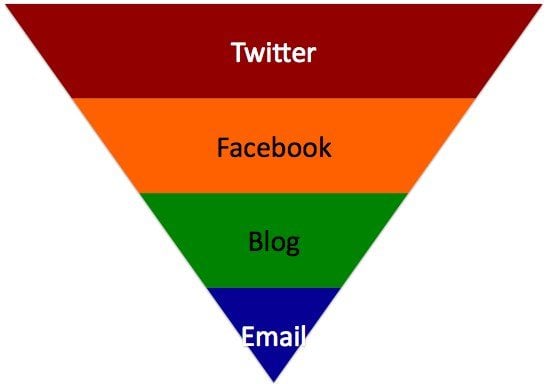
The key to a content ladder is organizing your rungs. Your scenario may of course vary, but for illustration purposes let’s assume you have a Twitter account, Facebook fan page, blog, and email newsletter.
To create an efficient ladder, you must understand the comparative publishing schedules that you typically employ for each of these outposts. Ordered from most frequent publication to least, let’s assume that your program looks like this:
• Twitter (5x/day)
• Facebook (2x/day)
• Blog (3x/week)
• Email (1x/week)
social content ladder Build Your Brand a Social Content Ladder in 5 Steps
Create your own integrated frequency schedule to better understand how your outposts interrelate.

4. Test & Track

Create a piece of content (remember to include your key phrases), and post it to the first rung in the ladder (Twitter, in this case) Use a tracking system (I prefer bit.ly) to determine how popular that specific piece of content was with your audience.
Remember however, that many factors influence popularity at the individual content piece level. Don’t make assumptions – test them. Vary time of day, day of week, phrasing, link placement, and other options, and thoroughly document your results.
Social media scientist Dan Zarrella has some excellent research on social content best practices.

5. Tweak and Repurpose

The content pieces that are most successful on the first rung of your ladder should be appropriately tweaked and redeployed on the second rung of your ladder (Facebook).
Test and track content success on Facebook using bit.ly (or number of likes and comments), and add the most effective content pieces to the next rung on the ladder (blog). Note that as you move down the ladder, your repurposing will be more complex – a blog post requires substantially more content than a Facebook update in most cases.
If a piece of content is successful on your blog (measured by visits as determined by Google Analytics, perhaps), add it to the next rung – your email newsletter.
By understanding how your various social outposts can work together at the content level, you can develop meaningful efficiencies. Also, because a sprinkling of the content included in the lower rungs of your ladder has already proven successful on higher rungs, the relevancy and popularity of your content should increase for most fans/readers/subscribers.
Of course, this content ladder approach assumes that you do not have the exact same audience for each of your social outlets, and I believe that to be an entirely realistic assumption. You may have some overlap (especially with Facebook and Twitter), but consumption of status updates and consumption of blog posts and email newsletters are meaningfully different activities, and attract different groups of fans.
What do you think? Worth a try?
sumber: http://www.convinceandconvert.com/integrated-marketing-and-media/build-your-brand-a-social-content-ladder-in-5-steps/

Friday, February 28, 2014

Kata siapa UKM tidak boleh gunakan sosial media ??


come-in-signSmall- and medium-sized businesses are growing rapidly, contributing over $5.5 trillion in annual revenue to our economy last year. As business grows, so does the "how" of conducting business. In particular, more and more companies are turning to social media networks to market their product, learn about new trends, and interact with customers. 
LinkedIn conducted a survey in November 2013 of one thousand North American businesses with revenue ranging from $1 million to $50 million to determine how small- and medium-sized businesses use social media today. I've highlighted some of the best takeaways below, but you can take a look at the full presentation if you're interested in a deep dive on the data.

How SMBs Are Using Social Media: 15 Stats You Should Know

1) SMBs contribute $5.5 trillion in annual revenue to the U.S. economy. (Tweet This Stat)
2) Social media is used by over 1 million SMBs in North America. (Tweet This Stat)
3) 8 out of 10 SMBs use social media for their business to drive growth. (Tweet This Stat)
4) 94% of SMBs who use social media use it for marketing. (Tweet This Stat)
5) 3 in 5 SMBs say they've gained new customers by using social media. (Tweet This Stat)
6) 49% of SMBs use social media for learning, specifically to access a network of peers and to learn from industry experts. (Tweet This Stat)
7) 79% of SMBs say that industry specific news and articles are the most valuable pieces of content they look for on social media, followed by client reviews and testimonials. (Tweet This Stat)
8) 64% of SMBs are in growth or "hyper growth" mode -- meaning revenue YoY has increased. (Tweet This Stat)
9) 73% of companies in hyper growth mode have also increased their social media spending. (Tweet This Stat)
10) Only 47% of SMBs have increased their spending on offline ads. (Tweet This Stat)
11) 82% of SMBs in "hyper growth" (significant increase in revenue YoY) say that social media is effective for generating leads. (Tweet This Stat)
12) The top social media goals for companies in hyper growth are maintaining a company presence online and delivering content from the company. (Tweet This Stat)
13) 3 out of 4 SMBs believe LinkedIn helps them build credibility. (Tweet This Stat)
14) 2 in 3 SMBs say that LinkedIn gives them the opportunity to connect with vendors and other partners. (Tweet This Stat)
15) 88% of SMBs in hyper growth use social media to generate word of mouth about their company. (Tweet This Stat)
Are you an SMB interested in using LinkedIn to improve your business success? LinkedIn recently launched a website specific to the needs of small businesses. Check it out here to learn how you can start on LinkedIn today.