Translate

Monday, January 06, 2014

Menyelaraskan kembali Sales Anda


Redefining Sales for Ethical and Sustainable Business

3p Contributor | Friday January 3rd, 2014 | 0 Comments
money on treesBy Peri Shawn
Many business people talk passionately about growing their businesses. Yet, in the same breath, they also speak about their dislike of sales. This is like holding aspirations of winning the New York City Marathon, yet, having an aversion to running.
Part of the reason sales has such a bad reputation is because we have developed and accepted sales stereotypes as truths. People often perceive sales as deceptive and manipulative. As a result, the word “sales” usually takes on a negative connotation. According to a recent study by Daniel Pink, when “sales” is mentioned, we often picture the stereotypical used car salesman.
If we hold a negative perception of sales, we decrease our chances of establishing sustainable business and supporting a healthy sales environment that satisfies the triple bottom line – people, planet and profit.  Here are three ways to avoid that.  After all, who wants to be perceived as the stereotypical used car salesman?
1.  Since our definition of sales ultimately informs our sales behaviors, we can start by updating our definition of sales to the following:  selling is about helping others with their buying decisions.  The operative word is “help.”  With this updated definition comes a more ethical set of sales behaviors that makes it obsolete to twist arms to slam dunk a close.
2.  Next we can identify which of the ten biggest sales mistakes we are committing.  This ensures we are treating prospects in a way that fosters relationships, the environment and business.  When we commit sales mistakes, we reduce the likelihood of closing a sale, often making the sale feel more self-serving rather positioning ourselves as valuable contributors and partners.
These sales mistakes are:
  1. Not being clear who’s buying
  2. Forgetting why people buy
  3. Being self-focused
  4. Telling mistruths
  5. Being ill-prepared
  6. Taking too much of the client’s time
  7. Sharing what’s not relevant
  8. Missing prospects’ buying cues
  9. Acting like a traditional salesperson
  10. Treating clients as enemies
If we don’t identify and rectify these sales mistakes, we run the risk of reducing our sales behaviors to those of the stereotypical used car salesman.
3.  The next step is to fully commit to our ongoing sales improvement.  The most effective way to do this is with sales coaching.  Sales coaching is about learning more quickly from our experience.  It helps us determine what’s working and what isn’t so we can adjust our sales conversations to better match the needs of our prospects and clients.
One of the keys to ensuring our sales coaching works (truly reflecting our ethics and business goals) is to ensure it is system-wide and multi-leveled.  This is integral to creating an engaging sales coaching culture that creates sustainable results.
When Sales VPs are coaching their direct reports, and when those directors are effectively coaching their managers, and when those managers are sales coaching their salespeople, they all hold one another accountable.  They each become an essential part of the organization’s sustainable sales coaching culture.
Having a sales coaching culture where each level is responsible to the one above ensures that the sales coaching operates as both a valuable informant for leadership decision-making and a catalyst for sales improvement.
When we leverage sales coaching to discover how our salespeople are defining sales and reduce the number of sales mistakes they commit, we know more about what is going on so we can guide our businesses to be more congruent with our ethics and business goals.  The by-product of sales coaching, when done well, is staff morale and customer satisfaction improves.
Saturday, January 04, 2014

Sekarang bisa Mention di Blogger (asyik!)

Sekarang bisa Mention di Blogger juga. +Weywey Dermawan +Daya Cipta Mandiri Fanky Christian

Mentions in Blogger

To use this feature, you first need to upgrade your Blogger profile to a Google+ profile.
Mentioning someone is an effective way to let them know that you're referring to them in your blog post. You can mention a person, or a Google+ page, even if they don't follow you. Depending on how they've configured their Google+ settings, they might receive a notification about your mention after you publish the post.

How to mention others

To use this feature, just type "+" or "@" followed by the name or page. As you’re typing, you'll see a list of names appear below. You can click to select the person or page that you'd like to mention.
If you've configured your settings to share your blog posts to Google+, you'll see that the names of the people you've mentioned in your post will be automatically added to the share box.
Related: Learn more about mentions in Google+.

Apa sih BPM ?


BPM stands for Business Process Management.  There are 2 different aspects of BPM: BPM as management discipline and BPM as software engineering.  The BPM vendors have long time tried to make abstraction of those 2 distinct aspects.  That path lead to more confusion then anything else.
BPM as a management discipline is the responsibility of every strategic executive manager.  It's to ensure that the organization performs well in their core business processes.  This involves understanding what values the organization delivers and how those are achieved.  This means analyzing, documenting and improving the way that people and systems work together.  As part of that work, it's useful to work with models and diagrams.   BPMN diagrams express the execution flow of the steps to accomplish a certain goal.   Important to note that these models are used for people to people communication.  They can be underspecified, which means that they can contain valuable high level information without including unnecessary details.  Such underspecified process models are also known as abstract business processes.
BPM as software engineering means that executable business processes will be executed by a BPM System (BPMS).  Executable business processes are based on a diagram that represents the different steps in an execution flow.  The diagram can actually look exactly the same as the abstract business process.  But executable business processes are different in some very fundamental ways.  First of all they need more technical details.  That part is generally accepted.
But what is less understood is that executable processes only take the perspective of a single system, the BPMS.  The BPMS can act as a coordinator, so steps in the process could be for example user tasks.  Then the user task becomes a wait state for the BPMS.  And when the external task is completed, then the BPMS acting as a coordinator should be informed about the completion.   In that context, a BPMS often acts as a state machine.   So it's clear that the BPMS, even as a coordinator, can not handle steps between 2 external parties.  For example, warehouse clerk handing over an order to a packager that wraps the order package.  Imagine none of that is automated, then there is no way of the BPMS to be informed about those steps.  So they can't be modeled distinctly in the executable business process.
Another less known difference between abstract and executable business processes is that executable processes are part of the software development lifecycle.  That implies they are under the control of the technical developers and that executable processes need unit testing just like any other piece of software.  
Traditional BPM vendors try to abstract those differences with automagical round tripping between abstract process models and executable process models.   But in general, that approach fails in practice.  At Activiti, we've developed an innovative vision to deal with these differences.  The Process Cycle Layer will be a cornerstone in this strategy.

Nintex Workflow


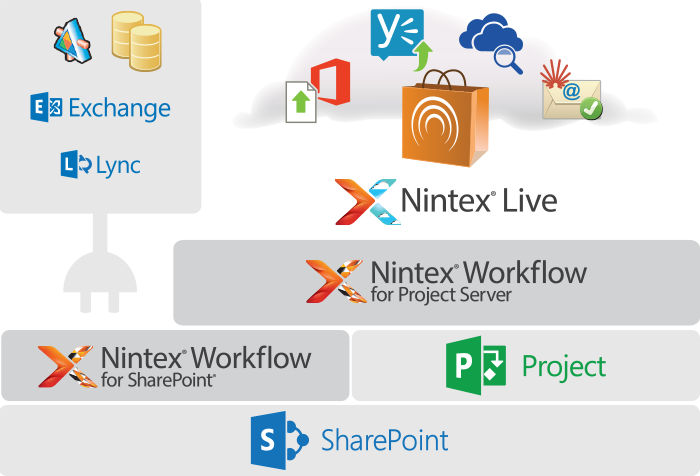
Nintex Workflow for Project Server
Nintex Workflow for Project Server empowers project and portfolio managers to design and implement end-to-end workflows without the need for complex and costly development cycles. Nintex was named inGartner Inc's list of Cool Vendors in Program and Portfolio Management 2013 an exclusive list that highlights innovative vendors and their products and services.

 
Project, Portfolio and Collaboration Workflows
  • Demand management workflows to ensure portfolio governance
  • Event driven workflows that automate actions and alerts
  • SharePoint workflows to collaborate on project artifacts
Quick and Easy
  • Browser based, drag and drop designer within Project Server
  • No code required providing flexibility and lower costs
  • Simple deployment and management
Connect to Other Systems
  • Query project data using the Project Server Interface (PSI)
  • Connect to company wide Line of Business (LOB) data systems
  • Integrate with Office 365 sites and utilize cloud services via Nintex Live


Project, Portfolio and Collaboration WorkflowsDemand management workflows created with Nintex Workflow for Project Server are assigned to Enterprise Project Type’s (EPTs) and can be configured to present Project Detail Pages (PDPs)and set stage status through the lifecycle phases according to an organization’s EPM methodology. It is built with deep integration with Project Server so you create native Project Server workflows.
In addition, workflows can be associated to asynchronous Project Server events and kicked off based on events such as when a project is published, or a new resource is created. This helps ensure greater governance across an organizations’ project management practice by monitoring budgets and resource status.
The underlying Nintex Workflow integration with SharePoint helps improve collaboration and communications across the project team during project execution and management.

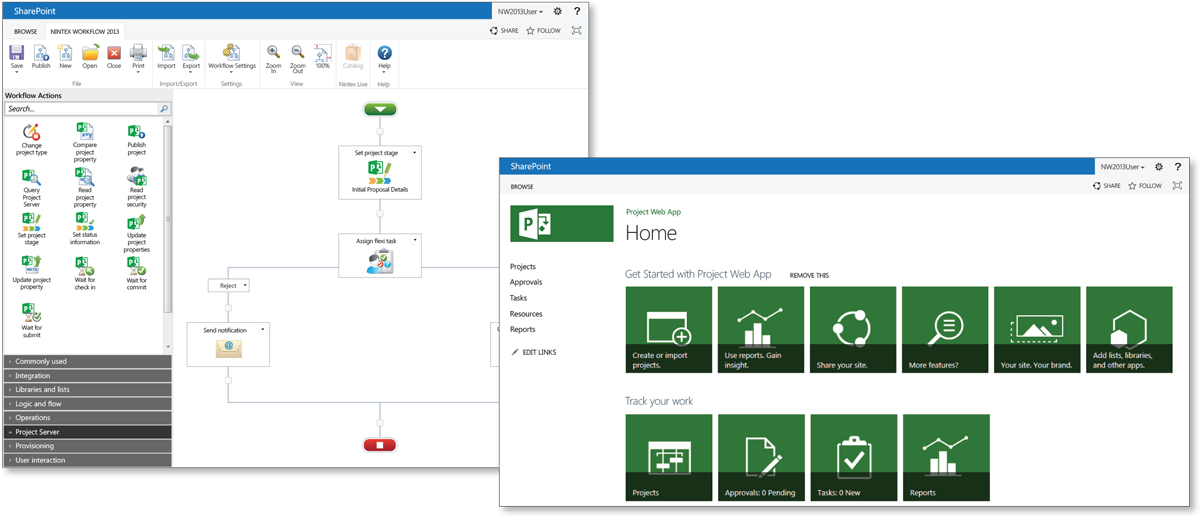
Design Workflows in Minutes Nintex Workflow for Project Server is a browser based designer embedded in the Project Web Application
• Draw, configure and update workflows by dragging and dropping actions onto the design canvas.
• Track their status visually and review reports all within the browser without the need for additional software.
• Save and reuse workflow logic across projects, departments and teams, or use templates to enforce standard processes and methodology
Leverage Nintex Workflow Connectivity 
Workflows created with Nintex Workflow for Project Server will connect to CRM, ERP and other LOB systems, as well as SharePoint Business Connectivity Services, Active Directory and Lync. Combined with the powerful Nintex Workflow actions, you are able to:
• Consume information from financial, human resources, billing and other disparate systems to create more complete workflows.
Unlock the data available within your Project Server instance via the Project Server Interface (PSI) or Project Server’s dedicated reporting database.
• Build processes that utilize Nintex Live to connect to an ever-growing catalog of online services and interact directly with Office 365, Yammer, Twitter, Bing and a World of Business and government information services
• Leverage out of the box integration with Exchange and Lync to schedule meetings and provide real time notifications.
• Create workflows that provide greater visibility into process status, compliance, bottlenecks, and participation. For example, you can analyze how long project approval requests take to be approved, how often requests are escalated, the time taken by each approver, etc.


* Nintex Workflow is required for Nintex Workflow for Project Server to operate.

Gartner does not endorse any vendor, product or service depicted in our research publications, and does not advise technology users to select only those vendors with the highest ratings. Gartner research publications consist of the opinions of Gartner's research organization and should not be construed as statements of fact. Gartner disclaims all warranties, expressed or implied, with respect to this research, including any warranties of merchantability or fitness for a particular purpose.

Beda workflow dan Project management ..


What’s the difference between workflow and project management?

As concepts, project management and workflow are similar and related concepts, but they’re not interchangeable. They’re not the same thing.
When I discuss workflow, I’m discussing the order or tasks required to reach a goal such as recording a song. Usually a workflow is short and general enough that it can be applied over and over again. For example, a workflow for a recording song might be used ten or twelve times for an album. It’s often a repeatable series of steps that has worked in the past and is likely to work in the future.
Workflow is extremely useful because it provides a degree of measurability and predictability to the production process. It allows you to determine how long it’ll take to complete a piece of work. It will help you schedule the work so that you have a high degree of confidence that it’ll be complete within the expected timeframe.
Project management, on the other hand, is about taking care of the bigger picture. I see it as two sets of activities:
  1. Planning and coordinating. This includes balancing cost and time requirements for different components of the project, recruiting and coordinating people, negotiating arrangements with partner businesses and tracking progress against the plan. Planning and coordinating needs to be done in full knowledge of the time and resource constraints of the project. This is the easy part.
  2. Responding to changes. All projects have hiccups. Humans are beautiful and messy and often unpredictable. Responding to changes can include activities that are primarily ‘mechanical’ – such as rebalancing resources, readjusting schedules and even changing the scope and outcomes of the project. It’s important to understand, however, that responding to changes often requires a human component too. Your artists and collaborators and partners are human beings and have feelings and desires and fears and you need to be mindful of this at all times. When plans change, people can feel hurt or disappointed. They might feel responsible (whether real or imagined). They probably have a different impression of you than you do of yourself – and the less you communicate the greater that difference will be.

Hindari jebakan kepemimpinan di 2014


Don't Fall In To These Leadership Traps In 2014

Hazard general
I have been a proponent of the importance of leadersdeveloping strengths as a means to improve toward excellence. After all, the best leaders are characterized by the presence of strengths, not the absence of weakness. That concept is illustrated in the article I coauthored for Harvard BusinessReview, called Making Yourself Indispensable. While it is clearly the path to developing the traits that allow a leader to stand out as remarkable, there are times when leaders need to address their areas of weakness. Some call these “derailleurs”, others call them “fatal flaws”, and still others, euphemistically, refer to them as “opportunities.” By any name, when those weaknesses overshadow a person’s strength, they have to be dealt with.
In my experience reviewing the data in thousands of 360-degree feedback instruments and consulting with senior leaders, these are the biggest traps that render them ineffective.
1. They are lousy role models. Leaders must be the exemplars of behaviors that are valued by any organization. They need to walk their talk and need to talk their walk. That is, they need to behave consistently with the standards set forth and actively support those standards verbally, combining actions and expressions to reinforce the desired actions.
2. They have poor interpersonal skills. We have all experienced leaders that are brilliant technically, or who possess incredible strategic thinking ability but who are abrasive, rude, and harsh to work with. As a result, they create a negative environment that stifles creativity. In other cases, a leader may simply lack any emotional engagement with others, and have simply transactional relationships. In my executive coaching work, this is by far the most common reason I get called.
3. They neglect the development of bench strength. Coaching, mentoring and developing others are the key areas of competence, when it comes to battling the inevitable attrition that occurs in a majority of organizations. When leaders fail to prioritize staff development, it not only hurts the future of the organization, it creates disengagement among individuals as they feel they are not being invested in.
4. They are closed-minded. These leaders have their way of doing things, (most often the way things have always been done,) and they are not interested in new ideas. In fact, they actively shut down suggestions from others and smother innovation. They reject even exploring new ideas on the basis that they know best.
5. They lack positive energy. Not to mention the harmful influence of negative energy. Even in a neutral state, a leader who is too often phlegmatic can come across as apathetic. No leader can be expected to hold elevated levels of enthusiasm at all times, but at least part of the time, people expect to see passion and even a little fire. The implication of this lack of positive energy is low levels of engagement for those who are lead.
6. They build silos. Collaboration, teamwork, and shared goals are more and more required for success in organizations. One of my clients is fond of saying that the profit dollars for the business “falls through the cracks between the silos.” Leaders who don’t take into account their influence on others, and think only of what their team needs, are too often, not acting in the best interest of the whole organization.
7. They fail to paint a compelling picture of the future. Few employees are motivated by the completion of tasks alone. Most want to understand their part in making the vision of the organization come to life. Providing clear strategy and direction for employees, is one of the critical success factors for leaders. Without it, individuals become mired in tasks and adrift from the mission.
At the end of the day, the saddest part about leaders who routinely exhibit these characteristics is that they are often unaware of them and the impact they are having. These leaders tend to have a very different view of themselves that others do and that gap creates problems for them. I have had to have very direct conversations with clients about the implications of their behaviors and the consequences of not changing. Frequently, that feedback can be a self-correcting mechanism as few leaders show up each day wanting to do a poor job.
Each of us needs to excel by leveraging our natural strengths and abilities. Peter Drucker pointed this out in The Effective Executive over 40 years ago, and that body of work continues to evolve today. But we also need to be mindful of avoiding these leadership traps. Your success will be determined by it!

Friday, January 03, 2014

Analisa Kekuatan dan Kelemahan Bisnis Anda..


Analisis Kekuatan dan Kelemahan Bisnis Anda

20 Dec 2013 Hits : 954
Click to edit this image in Aviary
Metode yang paling umum digunakan untuk mengetahui kekuatan dan kelemahan bisnis dengan melakukan analisis SWOT alias strengths (kekuatan), Weaknesses (kelemahan), Opportunities (peluang), dan Threats (ancaman). Analisis ini dapat membantu Anda mengidentifikasi cara untuk meminimalkan pengaruh kelemahan sambil memaksimalkan kekuatan dalam bisnis Anda.
Langkah menganalisis kekuatan pada dasarnya bertujuan untuk mendefinisikan keunggulan kompetitif bisnis Anda. Beberapa pertanyaan untuk dijawab meliputi:
  • Apakah bisnis Anda berjalan dengan baik?
  • Apakah bisnis Anda dikenal di pasar?
  • Apa akses sumber daya yang Anda miliki (manusia, keuangan, kekayaan intelektual)?
Sedangkan tujuan menganalisis kelemahan adalah untuk mencari titik-titik di mana Anda perlu melakukan peningkatan.
Beberapa hal yang harus digali adalah:
  • Apa yang tidak berjalan dengan baik pada bisnis Anda?
  • Apa yang tidak disukai pelanggan dari produk atau jasa Anda?
  • Dimana titik-titik tekanan dalam bisnis Anda?
  • Apa yang lebih baik dari pesaing Anda?
Sedangkan langkah analisis peluang bertujuan untuk menetapkan daerah di mana Anda bisa mengembangkan bisnis di masa depan. Beberapa pertanyaan untuk dijawab meliputi:
Tren bisnis seperti apa yang mampu menjadi peluang bagi Anda (teknologi, perubahan  demografi atau sosial, perubahan aturan)?
  • Produk baru apa yang dibutuhkan pelanggan Anda?
  • Apa yang akan melengkapi penawaran produk Anda saat ini?
  • Wilayah mana yang bisa Anda targetkan?
Pada tahapan terakhir, Anda harus mengkaji faktor eksternal dan internal yang dapat menciptakan masalah bagi bisnis. Beberapa pertanyaan untuk dijawab meliputi:
  • Apakah Anda kekuarangan sumber daya untuk mengembangkan bisnis?
  • Apakah pesaing mengancam bisnis Anda?
  • Apakah tren industri seperti perubahan teknologi atau perubahan aturan merupakan ancaman bagi bisnis Anda?
  • Apakah bisnis Anda rentan terhadap penurunan ekonomi atau perubahan ekonomi lainnya?
Entah dengan menggunakan pendekatan dasar atau lebih maju dari analisis SWOT, Anda pasti akan menjalankan bisnis kembali dengan pengetahuan yang baru. Gunakan ini untuk meningkatkan efektivitas perusahaan Anda dan sebagai masukan ke dalam bisnis. (as/berbagai sumber)