Translate

Thursday, January 02, 2014

Perbandingan antara Nagios dan PRTG

Perbandingan antara Nagios dan PRTG


What can actually cost a low purchase price

Nagios vs. PRTG: network monitoring on the cost-test

12/30/13 | Author / Editor : Sebastian Kruger / Andreas Donner
A comparison of the total cost may be worth before buying a monitoring tools thoroughly.
A comparison of the total cost may be worth before buying a monitoring tools thoroughly. (Picture: Paessler)
In the range of network monitoring solutions, the range is wide: open source, commercial products or island solutions of individual hardware manufacturers.But what fits best and is cheapest? But beware: Too strong a focus on savings in the acquisition does often not paid - on the contrary!
For smooth business operations, internal and external communications and the use of all IT systems trouble-free operation of the entire IT's infrastructure is a prerequisite in the company. Any failures in business processes become noticeable within a short time by time and especially financial losses.
So that it does not come that far, the use of a network monitoring solution is recommended. It monitors the availability of systems, services and applications as well as bandwidth consumption and informed immediately in case of emergency, the IT staff. This relieves administrators and noticeably improves efficiency, allowing them to use their know-how and time for the really important IT projects.
There is already a monitoring solution installed in the corporate network, a comparison is worthwhile: For surely there was at the time of purchase good reasons why the choice fell on this same product. But perhaps today to meet other requirements better solutions, for example in terms of monitoring performance, etc. In addition, of course, the budget plays a crucial role, which is why often as possible cheap or even free solutions given preference.Also, "handmade" systems consisting of different point solutions are not uncommon. What options do IT managers now if the existing monitoring solution or renewed for the first time such a system should be purchased?

Open Source: sticking point cost

Open-source software is widely used due to the ease of availability. Users cherish the hope of being able to cost-effectively set a proper solution in a short time. Such systems can usually customize and are royalty-free available. However, may be associated with above-average effort, the implementation and configuration, but also the operation of the open-source software.An open-source product can usually not be used without background knowledge, or alternatively an external service take care.

Welcome to the self-help group "Open Source Administration"

From a technical perspective the often high implementation and adaptation needs is a major drawback of open source solutions. As a rule, only basic functions in the freely available software are included which are not sufficient to monitor an IT infrastructure in detail.
In a network monitoring solution means: Too many processes and parameters remain unobserved and the network is still vulnerable to undetected faults. An example of a popular open-source solution is Nagios. The software offers many different modules for monitoring of networks, hosts and special services. Through a web interface, the admin view the collected data, however, make any adjustments. In addition, look for users of open source solutions, often in vain for product support. IT managers need to find the solutions to problems even then. While there are about network monitoring some online forums or communities, although this does not guarantee that specific responses are present. Users are therefore not always able to efficiently monitor their network and promptly integrate new devices into the monitor.
Another weak point may be the development of the solution: Based on the open source design, the user must rely on the fact that members of the community feel called to update the product continuously.

The option: the all-in-one package

Go another way commercial "out-of-the-box" solutions such as PRTG Network Monitor by Paessler. They provide for a general monitoring functions and other special features for individual areas.
For example, these systems dominate conventional protocols such as SNMP , WMI, HTTPand xFlow. They offer it in most cases a wide range of pre-configured monitoring capabilities and functionalities (eg POP3, Exchange, SQL , Virtual Server, etc.). If new equipment or expanding the network, they can be integrated into the monitoring and the new elements with a few clicks. In addition, usually a professional and timely technical support is available, as well as continuous updates.

Costs calculator makes thought tangible Games

For professional All-in-One solutions companies need - other than perhaps feared - not spend a fortune. An example calculation has shown that it is possible with the introduction and operation of PRTG against Nagios savings within the first 12 months, more than 5,000 euros.
The basis for the calculations an IT infrastructure with redundant virtualization , easy storage, associated networking components including Wi-Fi and of course common applications for email , database, ERP and Web-Site/-Shop. This saving corresponds to approximately 52 hours of work, which may invest a capable Linux expert within the company makes more sense than in the establishment and operation maintenance of a software that actually easy to run in the background and there is also finished as All-in-One Solution .
If you want to understand the calculation or recalculate the scenario for themselves, may be under http://www.de.paessler.com/nagios-alternative further information and to download an excel sheet for calculation.

Conclusion

When purchasing a network monitoring solution not only the purchase price should be at the forefront. Because this often important functions fall by the wayside. The result is high, internal programming, there is a lack of professional support and conscientious updates. It must also often must not be so deep into the pocket as expected, to obtain a comprehensive, high quality product with manufacturer support.

About the Author

Sebastian Kruger is a Partner Account Manager at Paessler AG.

Wednesday, January 01, 2014

11 Prediksi sosial media 2014

http://www.socialmediaexaminer.com/social-media-predictions-2014/

social media viewpointsAre you wondering what changes and trends are coming to social media marketing in 2014?
In 2013, we saw some big changes.
Major platforms made serious strides toward monetization and there was a massive rise in visual marketing.
To find out what the new year may have in store for social marketers, we asked 12 social media pros what they think is coming our way.
Here’s what they had to say.
And if you’re curious, here were the 2013 predictions.

#1: The Resurgence of Advertorial

jay-baer
Jay Baer
Several trends and technologies will reach maturity in 2014 spawning considerable disruption in social media, but I believe native advertising and sponsorship will have the greatest impact. It’s a back-to-the-future scenario.
advertorial-future
The future of marketing looks much like its past. Image source: iStockphoto

In the 1950s, product placement and “this episode of Your Hit Parade is brought to you by Lucky Strike cigarettes” was the norm when companies wanted to reach prospective customers. We then steadily moved away from integrated advertising for decades.
But now, native adverting is back and 2014 will be the year that Advertorial 2.0 becomes a major part of the social media marketing mix for most companies.
The days of social media being “free” marketing for companies are over. Facebook, Twitter, LinkedIn, Instagram and Pinterest are all in full monetization mode now, and companies looking to reach their fans/customers/prospects via these venues are going to need to pay to do so.
This has far-reaching implications for social media users, the concept of authenticity, what is and is not journalism, marketing budgets, the role of agencies and whether the future is more “social” or more “media.” Like it or not, I’m betting on the latter.
Jay Baer, founder of the award-winning blog Convince & Convert, co-author of The Now Revolution and author of Youtility: Why Smart Marketing Is About Help Not Hype.

#2: Employee Advocacy

neal-schaffer
Neal Schaffer
My prediction for 2014 is that employee advocacy will become a strategic initiative for more and more large companies.
Companies are always looking outside corporate walls for brand advocates in social media, but many of their most passionate advocates are also those who have deep ties to their company: their employees. Each individual employee has influence in his or her own unique social network, so the more employees who can help share the company’s social media messages, the broader the reach a company can achieve in social media.
To think of it in simple terms, if you had a sales and marketing team of 10 employees, your social media messages could be shared by either your corporate account or by your corporate account and potentially 10 more people.
employy-advocacy
Imagine the extended reach your employees’ advocacy will bring you.
Many companies are beginning to realize the exponential power of employee advocacy, especially on professional networking sites like LinkedIn, and I predict it will have a breakout year in 2014. Creating a successful employee advocacy program has its challenges, but the evolution of both social business as well as employee advocacy platforms should move this program forward in many companies in 2014.
Neal Schaffer, author of Maximizing LinkedIn for Sales and Social Media Marketing and Maximize Your Social: A One-Stop Guide to Building a Social Media Strategy for Marketing and Business Success.

#3: Facebook Forces a Strategic Refocus

john-haydon
John Haydon
With Facebook squelching updates from pages, small businesses and nonprofits (that lack deep pockets for Facebook ads) will have to scrap the old approach of spamming the news feed and refocus in three ways.
strategy-word-cloud
Marketers will have to refocus their strategies. Image source: iStockphoto
Facebook marketers will refocus their efforts in 2014 in these areas:
  1. Become more useful in the news feed. This starts with listening to the storytellers within your fan base, and publishing content that is 100% about making them look useful and interesting to their Facebook friends.
  2. Wisely integrate other marketing channels like email, other social media and events to encourage current customers to share branded content. After all, Facebook is essentially word-of-mouth marketing that begins with real fans telling their friends!
  3. Finally start that blog you’ve been talking about. In the end, Facebook is about driving traffic to your website so that they buy, join your email list or make a donation. Publishing useful content on a blog is one of the best ways to achieve this across all social media channels.
John Haydon, founder of Inbound Zombie and author of Facebook Marketing for Dummies.

#4: Social Networks Develop A/B Testing Tools for Brands’ Organic Updates

nick-robinson
Nick Robinson
In 2014, these tools won’t be just for the brands with big media budgets. Once A/B testing tools for social media are rolled out, we’ll see an increase in the quality of content distributed across networks. This will have an enormous impact on social media marketing, if brands take advantage.
For the brands that do successfully use A/B testing tools for social media, they’ll see an increase in impressions, engagement, website visits and ultimately, leads and sales.
Think about how we approach email and website testing. These are environments where we have direct control over the elements. Social sites are a bit different due to being “rental property.” It’s extremely difficult to infuse science into the type of content you share, since there is less control over who sees social updates. The only way you can do this type of testing with the rigor needed is to fork over money for advertising.
In my eyes, it’s a win-win-win for the social networks, users and brands alike!
Nick Robinson, social media channel manager for SAP Americas and co-author of StumbleUpon for Dummies.

#5: Pay to Play

dave-kerpen
Dave Kerpen
Facebook has changed its news feed algorithm to hurt organic reach. Twitter is a public company that must drive revenues. Google+ has introduced ads.
dollar-icon
Paid social will become a necessity for brands. Image source: iStockphoto
In 2014, we’ll see increased pressure on companies of all sizes to pay to sponsor their posts to get more visibility, as getting consumers’ attention in social media becomes increasingly difficult. This will be hardest on small businesses that obviously have fewer resources than big brands.
Dave Kerpen is CEO of Likeable Local, chairman of Likeable Media and author of Likeable Social Media and Likeable Business.

#6: Fusion Marketing and Fusion Dashboards

viveka-von-rosen
Viveka von Rosen
I believe fusion marketing is going to become a very common catchphrase for us in 2014, and fusion marketing dashboards will be developed and available for us in the very near future.
While fusion marketing is not a new concept, the ability to truly integrate years of traditional marketing with the exciting digital marketing tools of the Internet and social media is going to become even more necessary!
And, as the concept of fusion marketing becomes more common, the need for fusion marketing dashboards that allow us to launch, manage and benefit from many different media campaigns all in one place will grow.
fusion-marketing-dashboard
Fusion marketing tools will become necessary.
While HubSpot and Marketo are two of the best-known marketing hubs, they aren’t affordable for all marketers, entrepreneurs and small businesses out there.
A lower-priced and easy-to-use fusion marketing dashboard that allows us to access, create, launch and manage traditional, digital and social media campaigns all in one place for an affordable fee can fill that gap in the marketplace.
Fingers crossed—that’s what I would like to see in the new year!
Viveka von Rosen, founder of Linked Into Business and author of LinkedIn Marketing: An Hour a Day.

#7: Social Storytelling Will Shift

simon-mainwaring
Simon Mainwaring
As a brand leadership firm that helps large corporations define and share their brand stories through social marketing, we constantly witness the struggle companies face to reconcile their existing cultures and marketing strategies with the new demands of real-time, mobile customer engagement.
An early reaction was to simply adjust marketing while leaving the organization unchanged. Then, facing increased scrutiny and demands for transparency, large companies looked inward to ensure that what they said about themselves through their marketing was actually true of their organization.
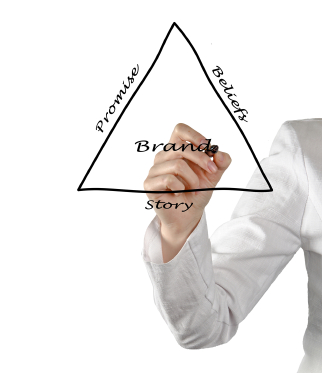
As internal and external storytelling align, my prediction for 2014 is the rise of coherent social storytelling.
brand-story
Brands will BE their story instead of telling it. Image: iStockphoto
This has huge implications for how brands use social media to build their reputation and sales, and for how consumers use social media as brand ambassadors. It will allow brands to shift their focus to their “story,” rather than its “telling.“ To focus on building relationships, rather than driving transactions. And to unlock the true power of social media, which is to inspire customers to build the business with them, based on shared values and a common goal.
Simon Mainwaring, founder and chief creative officer at We First Inc. and author of We First: How Brands and Consumers Use Social Media to Build a Better World.

#8: The Age of Advocacy

ekaterina-walter
Ekaterina Walter
With the hundreds of thousands of products launching every year and the amount of digital noise increasing exponentially, brands need a solution that allows them to distinguish themselves from that noise.
I see it happening two ways: either they have to consistently produce a viral hit (the chance of which is slim to none) or create a powerful advocacy engine that sparks sustainable word-of-mouth.
In the age of infobesity, advocacy becomes the most relevant filter. And byadvocacy, I mean the highest expression of brand love by a brand’s consumers, partners and employees. In the social era, the right form of advocacy becomes true influence.
Influence isn’t about impressions, it’s about impacting someone’s behavior. And the only way to impact the behavior of others is through passion, relevance and trust. Genuine organic love for a brand influences behavior much more than a paid promotion.
advocacy-stat
Brand advocacy will be more important than ever.
In 2014, brands will focus deeply on creating and nurturing long-term sustainable relationships with their true advocates through building smaller niche interest–driven communities.
We are entering the age of advocacy. Customers are no longer buying brands, they are investing in them. Marketers will move from marketing to their fans to marketing with and through them; from simply creating marketing campaigns to igniting brand movements.
Ekaterina Walter, cofounder and CMO of BRANDERATI and WSJ bestsellingauthor of Think Like Zuck and The Power of Visual Storytelling.

#9: Paid Social Becomes a Requirement for Social Media Marketers

mike-stelzner
Michael Stelzner
As social networks become more accountable to public shareholders, they will begin implementing “traditional” business models requiring that marketers “pay to play.” The organic marketing benefits of social media will continue to decline.
Social networks like Facebook, Twitter and LinkedIn will slowly introduce special features only to paying customers and reduce the benefits of organic activity.
paid-social
Learn the paid side of social or be left behind.
This shift will require marketers to go beyond engagement marketing strategies and deeply understand the paid side of social. Those that ignore paid social media will fall behind their competitors.
Michael Stelzner, founder and CEO of Social Media Examiner, founder of My Kids’ Adventures and author of Launch and Writing White Papers.

#10: Brand-Owned Network List-Building Matures

paul-colligan
Paul Colligan
Mark Zuckerberg has a network of a billion people—perhaps you’ve heard of it. Google has a video platform that sees a billion uniques a month. Apple has received more than a billion podcast subscriptions. 200 million users send 400 million tweets each day. We’ve built their networks, and we did a good job.
And 2014 will be the year we build our own networks. The stakes are too high not to.
While playing nice with the unique cultures that make up the different social networks, I predict we’ll turn our attention to building our own lists. This won’t always be the traditional email list, but will include phone numbers, physical mailing lists and more.
Right now, Twitter lead generation cards, trigger texting and Facebook offers are leading the way, and you’ll see more of this in the coming year (both in tools and implementation). When social media marketers realize that they can reach their entire list without paying extra for the honor, the tide will quickly turn.
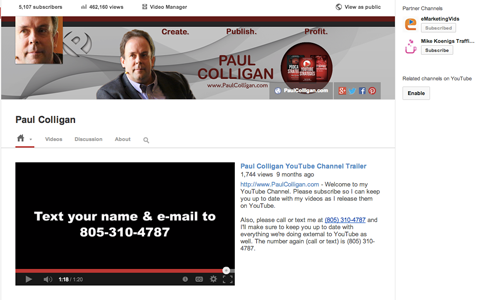
youtube-list-building
Building a list on YouTube? You bet!
Don’t worry, the change will be subtle, but the lists built will be significant (and profitable). Why shouldn’t we learn from the networks we helped build?
Paul Colligan, education czar for Traffic Geyser Inc. and CEO of Colligan.

#11: Interactive Video Becomes Viable

mark-schaefer
Mark Schaefer
I think this is the year we’ll see a real breakthrough in interactive video. When you think about it, our relationship with video has not changed significantly since 1950. Basically, we “observe.”
But the technology exists to “tag” based on audio content and even recognize faces and objects. Wouldn’t it be cool to search the web and get just the right snippet of video to answer a question or solve a problem (instead of the whole video)? Can you imagine adding a comment or even content to a video while you are watching it?
interactive-video
Searching video for tags or images may be right around the corner. Image source: iStockphoto


10 strategis Technologies di 2014


Gartner Identifies the Top 10 Strategic Technology Trends for 2014

Analysts Examine Top Industry Trends at Gartner Symposium/ITxpo 2013 October 6-10 in Orlando
Gartner, Inc. today highlighted the top ten technologies and trends that will be strategic for most organizations in 2014.  Analysts presented their findings during Gartner Symposium/ITxpo, being held here through October 10.
Gartner defines a strategic technology as one with the potential for significant impact on the enterprise in the next three years. Factors that denote significant impact include a high potential for disruption to IT or the business, the need for a major dollar investment, or the risk of being late to adopt.
A strategic technology may be an existing technology that has matured and/or become suitable for a wider range of uses. It may also be an emerging technology that offers an opportunity for strategic business advantage for early adopters or with potential for significant market disruption in the next five years. These technologies impact the organization's long-term plans, programs and initiatives.
“We have identified the top 10 technologies that companies should factor into their strategic planning processes,” said David Cearley. “This does not necessarily mean adoption and investment in all of the listed technologies, but companies should look to make deliberate decisions about them during the next two years.”
Mr. Cearley said that the Nexus of Forces, the convergence of four powerful forces: social, mobile, cloud and information, continues to drive change and create new opportunities, creating demand for advanced programmable infrastructure that can execute at web-scale.
The top ten strategic technology trends for 2014 include:
Mobile Device Diversity and Management
Through 2018, the growing variety of devices, computing styles, user contexts and interaction paradigms will make "everything everywhere" strategies unachievable. The unexpected consequence of bring your own device (BYOD) programs is a doubling or even tripling of the size of the mobile workforce. This is placing tremendous strain on IT and Finance organizations. Enterprise policies on employee-owned hardware usage need to be thoroughly reviewed and, where necessary, updated and extended. Most companies only have policies for employees accessing their networks through devices that the enterprise owns and manages. Set policies to define clear expectations around what they can and can't do. Balance flexibility with confidentiality and privacy requirements
Mobile Apps and Applications
Gartner predicts that through 2014, improved JavaScript performance will begin to push HTML5 and the browser as a mainstream enterprise application development environment. Gartner recommends that developers focus on creating expanded user interface models including richer voice and video that can connect people in new and different ways. Apps will continue to grow while applications will begin to shrink. Apps are smaller, and more targeted, while a larger application is more comprehensive. Devlopers should look for ways to snap together apps to create larger applications. Building application user interfaces that span a variety of devices require an understanding of fragmented building blocks and an adaptable programming structure that assembles them into optimized content for each device. The market for tools to create consumer and enterprise facing apps is complex with well over 100 potential tools vendors. For the next few years no single tool will be optimal for all types of mobile application so expect to employ several. The next evolution in user experience will be to leverage intent, inferred from emotion and actions, to motivate changes in end-user behavior.
The Internet of Everything
The Internet is expanding beyond PCs and mobile devices into enterprise assets such as field equipment, and consumer items such as cars and televisions. The problem is that most enterprises and technology vendors have yet to explore the possibilities of an expanded internet and are not operationally or organizationally ready. Imagine digitizing the most important products, services and assets. The combination of data streams and services created by digitizing everything creates four basic usage models – Manage; Monetize; Operate; Extend. These four basic models can be applied to any of the four "internets” (people, things, information and places).  Enterprises should not limit themselves to thinking that only the Internet of Things (i.e., assets and machines) has the potential to leverage these four models. Enterprises from all industries (heavy, mixed, and weightless) can leverage these four models.
Hybrid Cloud and IT as Service Broker
Bringing together personal clouds and external private cloud services is an imperative. Enterprises should design private cloud services with a hybrid future in mind and make sure future integration/interoperability is possible. Hybrid cloud services can be composed in many ways, varying from relatively static to very dynamic. Managing this composition will often be the responsibility of something filling the role of cloud service broker (CSB), which handles aggregation, integration and customization of services. Enterprises that are expanding into hybrid cloud computing from private cloud services are taking on the CSB role. Terms like "overdrafting" and "cloudbursting" are often used to describe what hybrid cloud computing will make possible. However, the vast majority of hybrid cloud services will initially be much less dynamic than that. Early hybrid cloud services will likely be more static, engineered compositions (such as integration between an internal private cloud and a public cloud service for certain functionality or data). More deployment compositions will emerge as CSBs evolve (for example, private infrastructure as a service [IaaS] offerings that can leverage external service providers based on policy and utilization).
Cloud/Client Architecture
Cloud/client computing models are shifting. In the cloud/client architecture, the client is a rich application running on an Internet-connected device, and the server is a set of application services hosted in an increasingly elastically scalable cloud computing platform. The cloud is the control point and system or record and applications can span multiple client devices. The client environment may be a native application or browser-based; the increasing power of the browser is available to many client devices, mobile and desktop alike. Robust capabilities in many mobile devices, the increased demand on networks, the cost of networks and the need to manage bandwidth use creates incentives, in some cases, to minimize the cloud application computing and storage footprint, and to exploit the intelligence and storage of the client device. However, the increasingly complex demands of mobile users will drive apps to demand increasing amounts of server-side computing and storage capacity.
The Era of Personal Cloud
The personal cloud era will mark a power shift away from devices toward services. In this new world, the specifics of devices will become less important for the organization to worry about, although the devices will still be necessary. Users will use a collection of devices, with the PC remaining one of many options, but no one device will be the primary hub. Rather, the personal cloud will take on that role. Access to the cloud and the content stored or shared from the cloud will be managed and secured, rather than solely focusing on the device itself.
Software Defined Anything
Software-defined anything (SDx) is a collective term that encapsulates the growing market momentum for improved standards for infrastructure programmability and data center interoperability driven by automation inherent to cloud computing, DevOps and fast infrastructure provisioning. As a collective, SDx also incorporates various initiatives like OpenStack, OpenFlow, the Open Compute Project and Open Rack, which share similar visions. As individual SDx technology silos evolve and consortiums arise, look for emerging standards and bridging capabilities to benefit portfolios, but challenge individual technology suppliers to demonstrate their commitment to true interoperability standards within their specific domains. While openness will always be a claimed vendor objective, different interpretations of SDx definitions may be anything but open. Vendors of SDN (network), SDDC (data center), SDS (storage), and SDI (infrastructure) technologies are all trying to maintain leadership in their respective domains, while deploying SDx initiatives to aid market adjacency plays. So vendors who dominate a sector of the infrastructure may only reluctantly want to abide by standards that have the potential to lower margins and open broader competitive opportunities, even when the consumer will benefit by simplicity, cost reduction and consolidation efficiency.
Web-Scale IT
Web-scale IT is a pattern of global-class computing that delivers the capabilities of large cloud service providers within an enterprise IT setting by rethinking positions across several dimensions. Large cloud services providers such as Amazon, Google, Facebook, etc., are re-inventing the way IT in which IT services can be delivered.  Their capabilities go beyond scale in terms of sheer size to also include scale as it pertains to speed and agility. If enterprises want to keep pace, then they need to emulate the architectures, processes and practices of these exemplary cloud providers. Gartner calls the combination of all of these elements Web-scale IT. Web-scale IT looks to change the IT value chain in a systemic fashion.  Data centers are designed with an industrial engineering perspective that looks for every opportunity to reduce cost and waste.  This goes beyond re-designing facilities to be more energy efficient to also include in-house design of key hardware components such as servers, storage and networks. Web-oriented architectures allows developers to build very flexible and resilient systems that recover from failure more quickly.
Smart Machines
Through 2020, the smart machine era will blossom with a proliferation of contextually aware, intelligent personal assistants, smart advisors (such as IBM Watson), advanced global industrial systems and public availability of early examples of autonomous vehicles. The smart machine era will be the most disruptive in the history of IT. New systems that begin to fulfill some of the earliest visions for what information technologies might accomplish — doing what we thought only people could do and machines could not —are now finally emerging. Gartner expects individuals will invest in, control and use their own smart machines to become more successful. Enterprises will similarly invest in smart machines. Consumerization versus central control tensions will not abate in the era of smart-machine-driven disruption. If anything, smart machines will strengthen the forces of consumerization after the first surge of enterprise buying commences.
3-D Printing
Worldwide shipments of 3D printers are expected to grow 75 percent in 2014 followed by a near doubling of unit shipments in 2015. While very expensive “additive manufacturing” devices have been around for 20 years, the market for devices ranging from $50,000 to $500, and with commensurate material and build capabilities, is nascent yet growing rapidly. The consumer market hype has made organizations aware of the fact 3D printing is a real, viable and cost-effective means to reduce costs through improved designs, streamlined prototyping and short-run manufacturing.
About Gartner Symposium/ITxpo
Gartner Symposium/ITxpo is the world's most important gathering of CIOs and senior IT executives. This event delivers independent and objective content with the authority and weight of the world's leading IT research and advisory organization, and provides access to the latest solutions from key technology providers. Gartner's annual Symposium/ITxpo events are key components of attendees' annual planning efforts. IT executives rely on Gartner Symposium/ITxpo to gain insight into how their organizations can use IT to address business challenges and improve operational efficiency.
Additional information about Gartner Symposium/ITxpo in Orlando, is available atwww.gartner.com/symposium/us. Video replays of keynotes and sessions are available on Gartner Events on Demand at www.gartnerondemand.com. Follow news, photos and video coming from Gartner Symposium/ITxpo on Facebook at http://www.facebook.com/GartnerSymposium, and on Twitter athttp://twitter.com/Gartner_inc and using #GartnerSym.